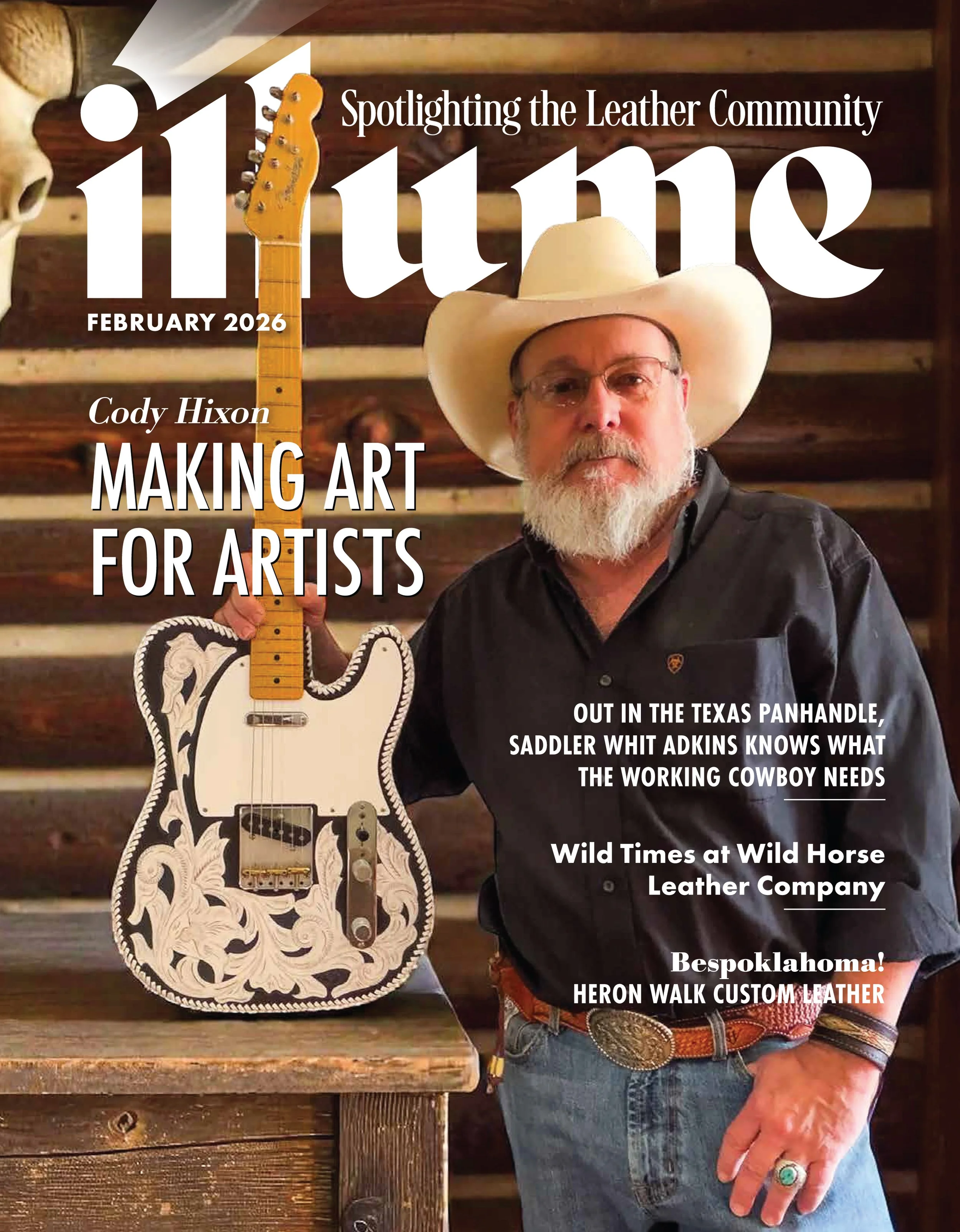
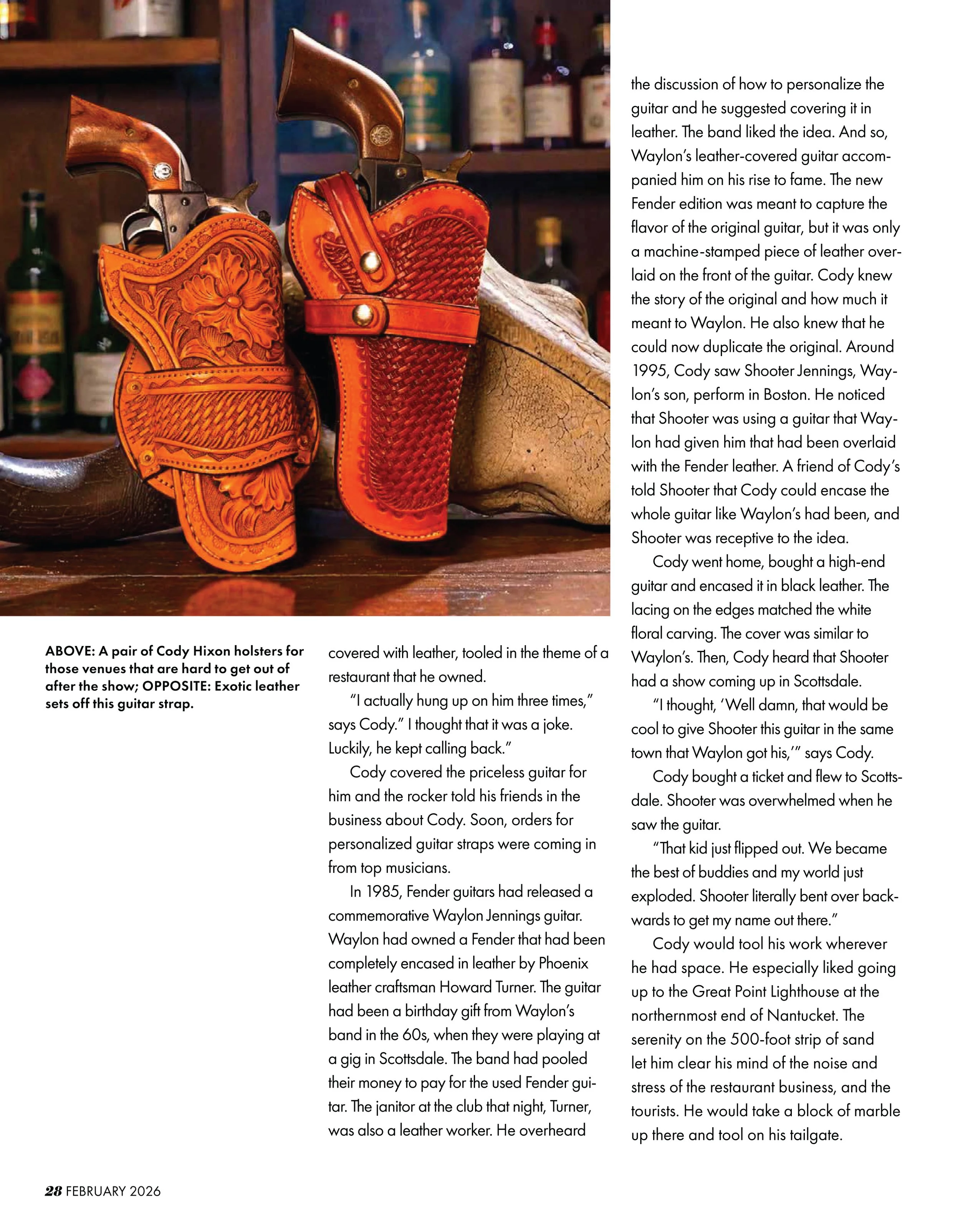
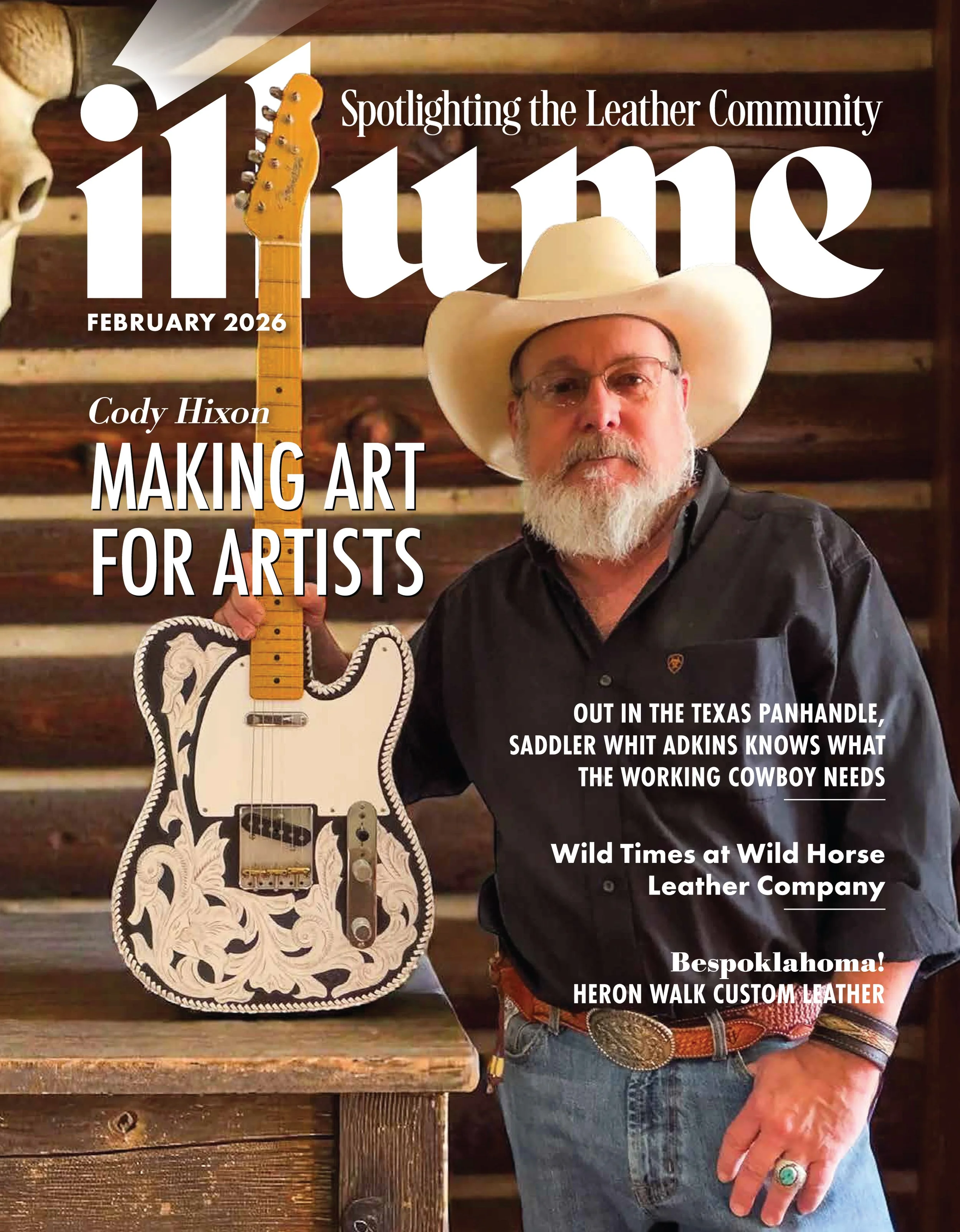
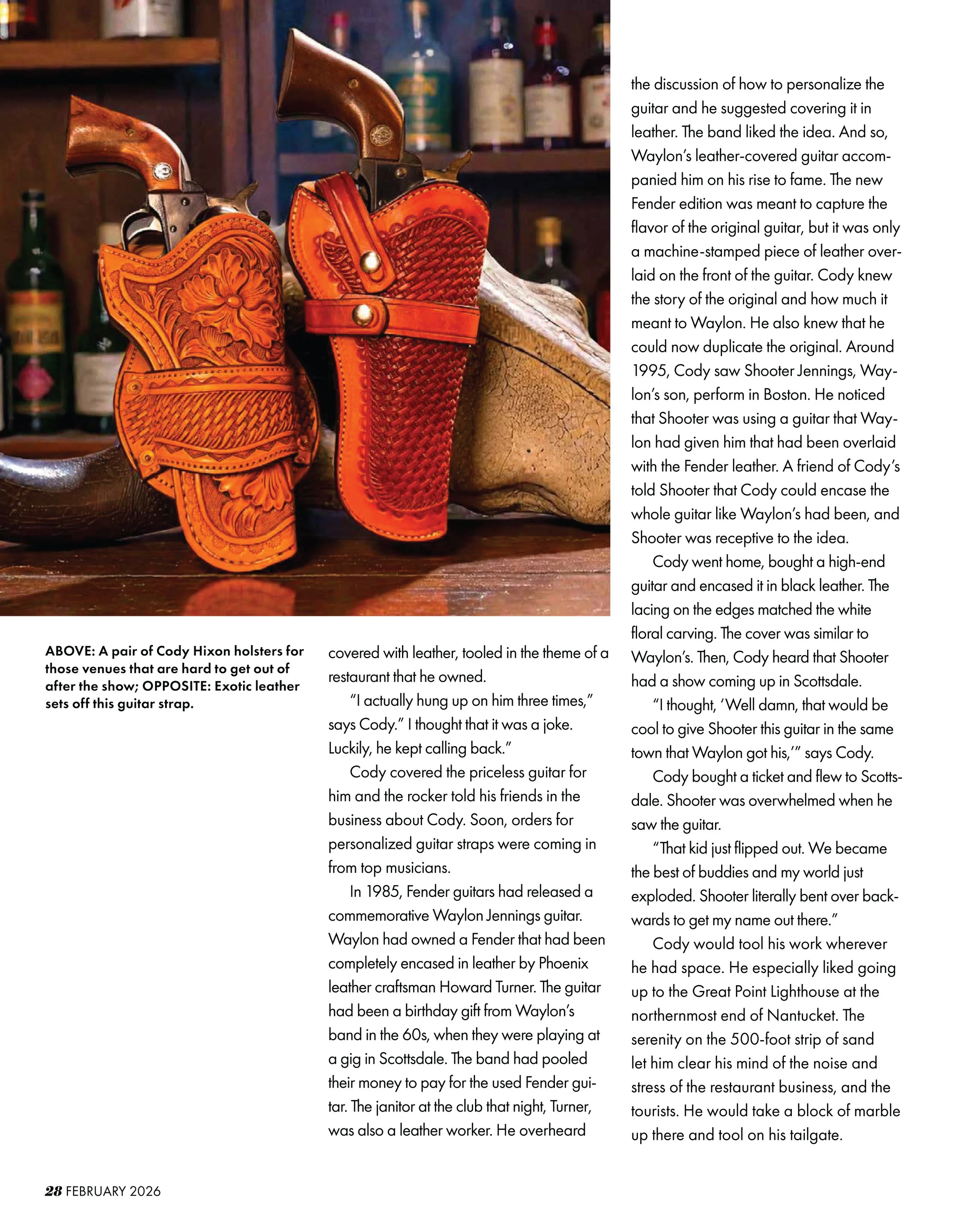
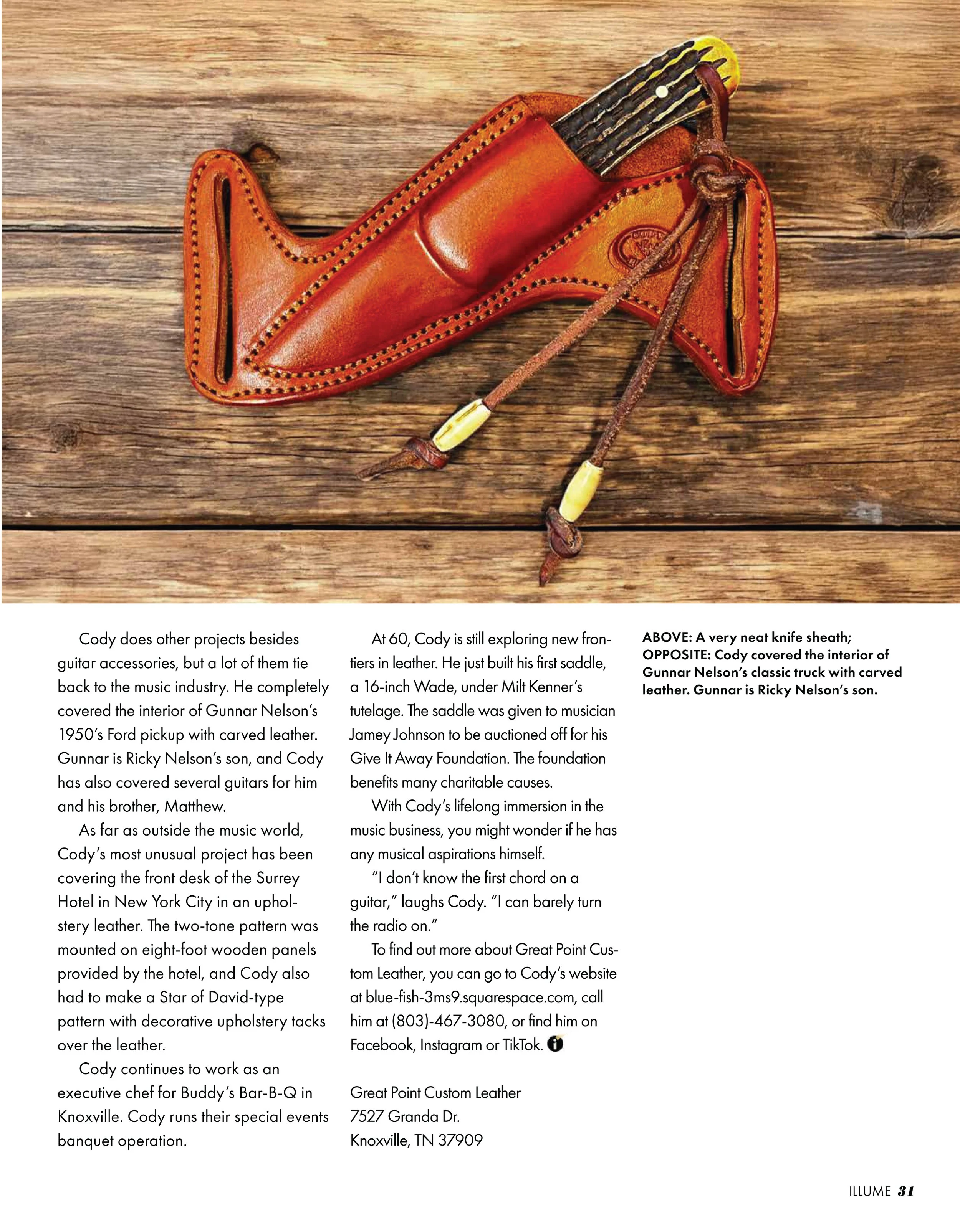
Featured in Illume Magazine

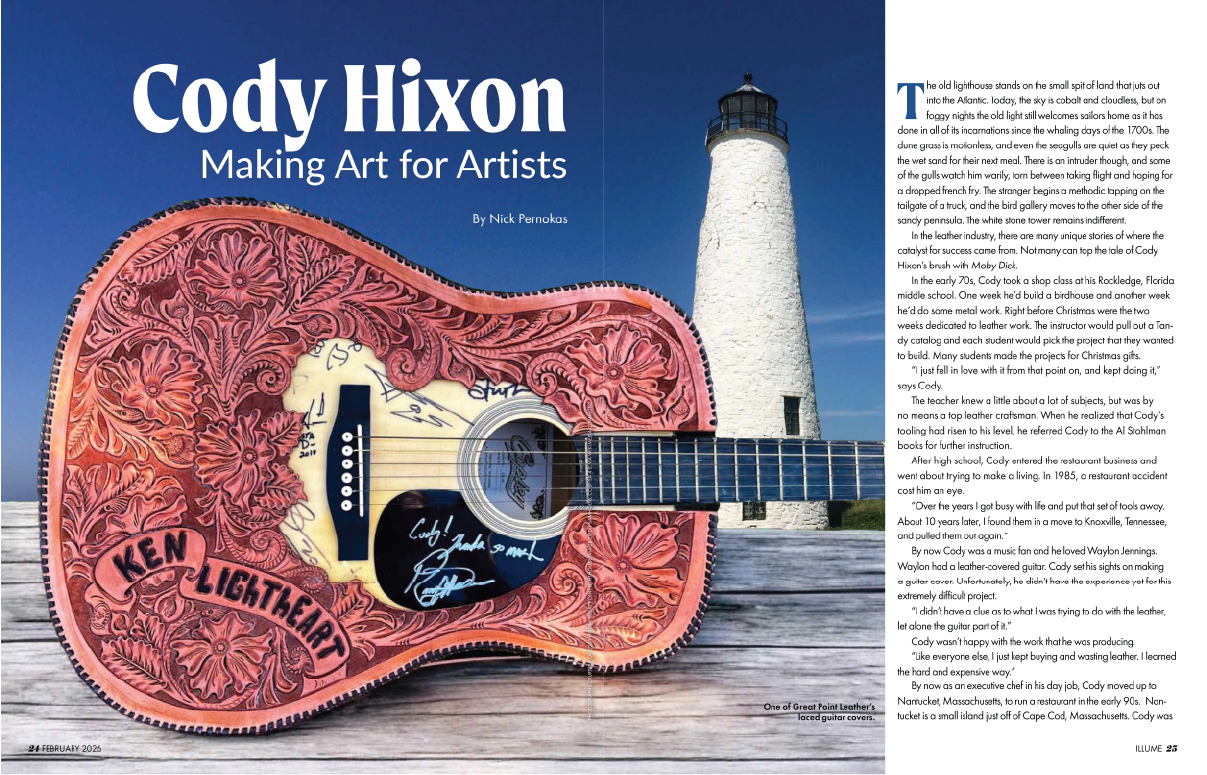
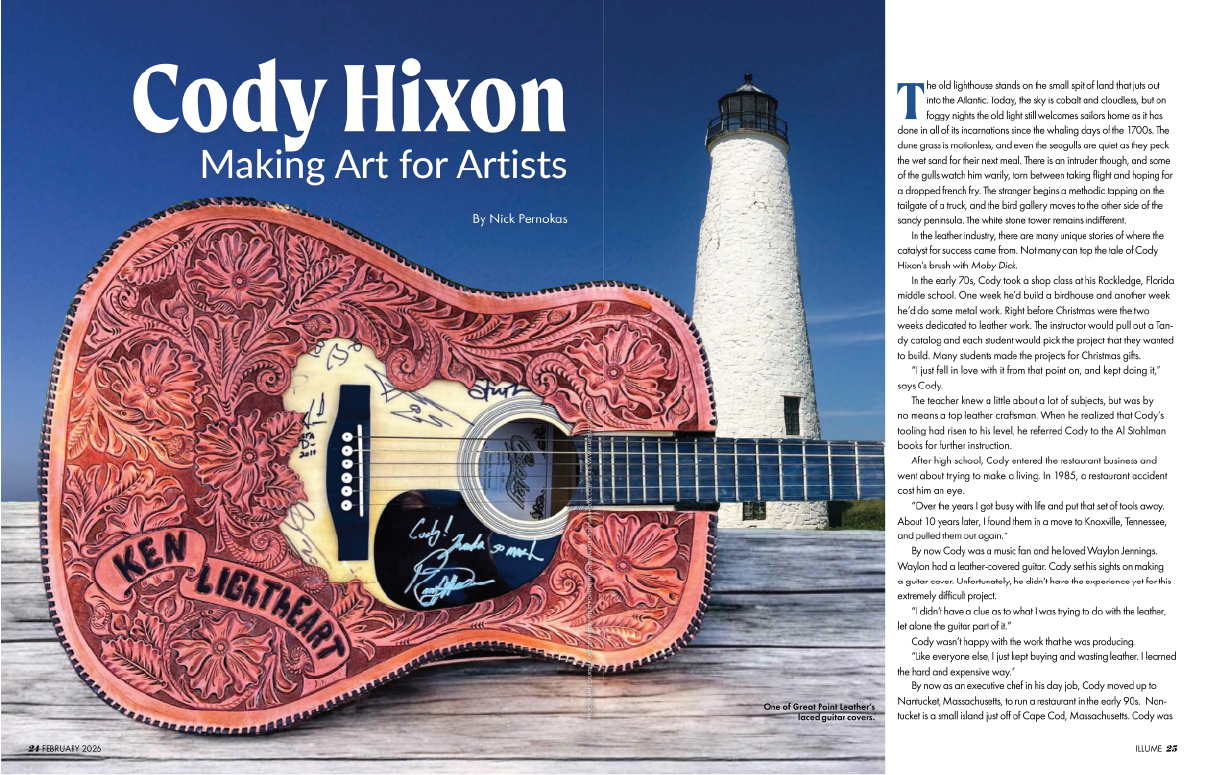
The old lighthouse stands on the small spit of land that juts out into the Atlantic. Today, the sky is cobalt and cloudless, but on foggy nights the old light still welcomes sailors home as it has done in all of its incarnations since the whaling days of the 1700s. The dune grass is motionless, and even the seagulls are quiet as they peck the wet sand for their next meal. There is an intruder though, and some of the gulls watch him warily, torn between taking flight and hoping for a dropped french fry. The stranger begins a methodic tapping on the tailgate of a truck, and the bird gallery moves to the other side of the sandy peninsula. The white stone tower remains indifferent.
In the leather industry, there are many unique stories of where the catalyst for success came from. Not many can top the tale of Cody Hixon’s brush with Moby Dick.
In the early 70s, Cody took a shop class at his Rockledge, Florida middle school. One week he’d build a birdhouse and another week he’d do some metal work. Right before Christmas were the two weeks dedicated to leather work. The instructor would pull out a Tandy catalog and each student would pick the project that they wanted to build. Many students made the projects for Christmas gifts.
“I just fell in love with it from that point on, and kept doing it,” says Cody.
The teacher knew a little about a lot of subjects, but was by no means a top leather craftsman. When he realized that Cody’s tooling had risen to his level, he referred Cody to the Al Stohlman books for further instruction.
After high school, Cody entered the restaurant business and went about trying to make a living. In 1985, a restaurant accident cost him an eye.
“Over the years I got busy with life and put that set of tools away. About 10 years later, I found them in a move to Knoxville, Tennessee, and pulled them out again.”
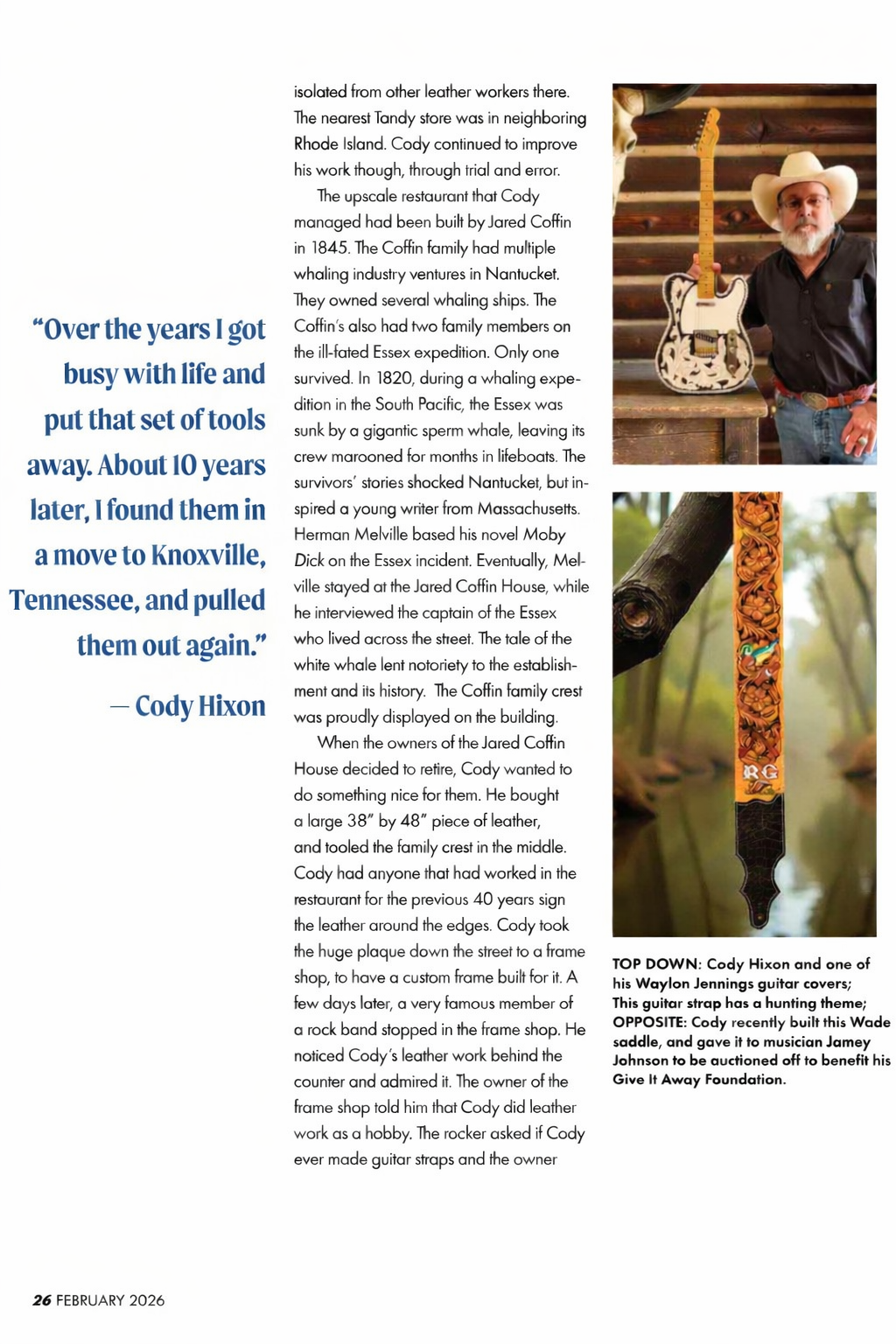
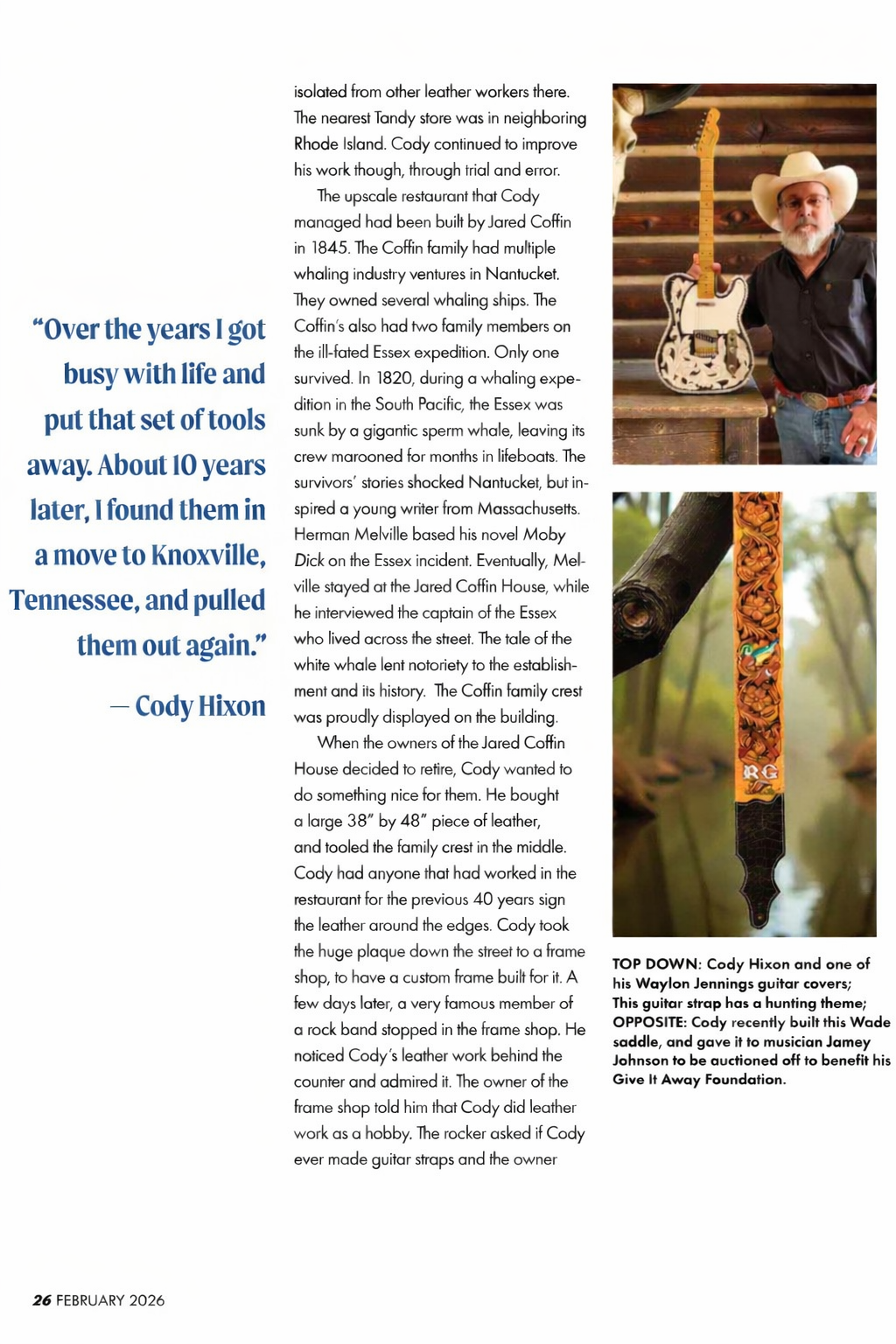
By now Cody was a music fan and he loved Waylon Jennings. Waylon had a leather-covered guitar. Cody set his sights on making a guitar cover. Unfortunately, he didn’t have the experience yet for this extremely difficult project.
“I didn’t have a clue as to what I was trying to do with the leather, let alone the guitar part of it.”
Cody wasn’t happy with the work that he was producing.
“Like everyone else, I just kept buying and wasting leather. I learned the hard and expensive way.”
By now as an executive chef in his day job, Cody moved up to Nantucket, Massachusetts, to run a restaurant in the early 90s. Nantucket is a small island just off of Cape Cod, Massachusetts. Cody was isolated from other leather workers there. The nearest Tandy store was in neighboring Rhode Island. Cody continued to improve his work though, through trial and error.
The upscale restaurant that Cody managed had been built by Jared Coffin in 1845. The Coffin family had multiple whaling industry ventures in Nantucket. They owned several whaling ships. The Coffins also had two family members on the ill-fated Essex expedition. Only one survived. In 1820, during a whaling expedition in the South Pacific, the Essex was sunk by a gigantic sperm whale, leaving its crew marooned for months in lifeboats. The survivors’ stories shocked Nantucket, but inspired a young writer from Massachusetts. Herman Melville based his novel Moby Dick on the Essex incident. Eventually, Melville stayed at the Jared Coffin House, while he interviewed the captain of the Essex who lived across the street. The tale of the white whale lent notoriety to the establishment and its history. The Coffin family crest was proudly displayed on the building.
When the owners of the Jared Coffin House decided to retire, Cody wanted to do something nice for them. He bought a large 38” by 48” piece of leather, and tooled the family crest in the middle. Cody had anyone that had worked in the restaurant for the previous 40 years sign the leather around the edges. Cody took the huge plaque down the street to a frame shop, to have a custom frame built for it. A few days later, a very famous member of a rock band stopped in the frame shop. He noticed Cody’s leather work behind the counter and admired it. The owner of the frame shop told him that Cody did leather work as a hobby. The rocker asked if Cody ever made guitar straps and the owner replied that Cody even covered guitars.
The musician called Cody and told him that he wanted one of his Les Paul guitars covered with leather, tooled in the theme of a restaurant that he owned.
“I actually hung up on him three times,” says Cody. “I thought that it was a joke. Luckily, he kept calling back.”
Cody covered the priceless guitar for him and the rocker told his friends in the business about Cody. Soon, orders for personalized guitar straps were coming in from top musicians.
In 1985, Fender guitars had released a commemorative Waylon Jennings guitar. Waylon had owned a Fender that had been completely encased in leather by Phoenix leather craftsman Howard Turner. The guitar had been a birthday gift from Waylon’s band in the 60s, when they were playing at a gig in Scottsdale. The band had pooled their money to pay for the used Fender guitar. The janitor at the club that night, Turner, was also a leather worker. He overheard the discussion of how to personalize the guitar and he suggested covering it in leather. The band liked the idea. And so, Waylon’s leather-covered guitar accompanied him on his rise to fame. The new Fender edition was meant to capture the flavor of the original guitar, but it was only a machine-stamped piece of leather overlaid on the front of the guitar. Cody knew the story of the original and how much it meant to Waylon. He also knew that he could now duplicate the original. Around 1995, Cody saw Shooter Jennings, Waylon’s son, perform in Boston. He noticed that Shooter was using a guitar that Waylon had given him that had been overlaid with the Fender leather. A friend of Cody’s told Shooter that Cody could encase the whole guitar like Waylon’s had been, and Shooter was receptive to the idea.
Cody went home, bought a high-end guitar and encased it in black leather. The lacing on the edges matched the white floral carving. The cover was similar to Waylon’s. Then, Cody heard that Shooter had a show coming up in Scottsdale.
“I thought, ‘Well damn, that would be cool to give Shooter this guitar in the same town that Waylon got his,’” says Cody.
Cody bought a ticket and flew to Scottsdale. Shooter was overwhelmed when he saw the guitar.
“That kid just flipped out. We became the best of buddies and my world just exploded. Shooter literally bent over backwards to get my name out there.”
Cody would tool his work wherever he had space. He especially liked going up to the Great Point Lighthouse at the northernmost end of Nantucket. The serenity on the 500-foot strip of sand let him clear his mind of the noise and stress of the restaurant business, and the tourists. He would take a block of marble up there and tool on his tailgate.
After his success with Shooter Jennings, a friend told him he needed a professional name for his work.
“That Great Point was just such a big piece of my life. I thought it was cool and nobody else would have had it.”
Great Point Custom Leather became a name with a positive vibe.
Cody continued working as an executive chef and traveled for several employers including Dave Thomas of Wendy’s. The leather work continued in his spare time. In 2006, he moved back to Knoxville, to be near to his mother and closer to Nashville.
In Knoxville, Cody met Diane Corey, who owned a leather shop. She became a mentor for Cody, helping him with supplies and techniques. Cody also met Milt Kenner, who was a well-known saddle-maker from Dandridge, Tennessee.
“With those two, my education really began.”
Bob Beard visited the area frequently and put clinics on at Diane’s shop. Bob became another inspirational friend.
Cody remembers Bob talking him into entering a guitar at the World Leather Debut in 2008, where it won third place. Cody had never heard of the show, but once he went, he was hooked. Jim Linnell was one of the judges that year and his comments became more feedback that helped Cody.
“I was very intimidated when I got there, but these people were so down to earth and they’d share any knowledge if you asked. Going to Sheridan that first year opened my eyes to another world that I didn’t realize was there.”
In 2023, Shooter Jennings and Fender Guitars commissioned Cody to make covers for 65 limited edition guitars with straps that were identical in every way to Waylon’s original. Cody even distressed the leather down to the “belt buckle rash” on the back of the guitars leather cover. The covered guitars were priced at $25,000 each. They sold out.
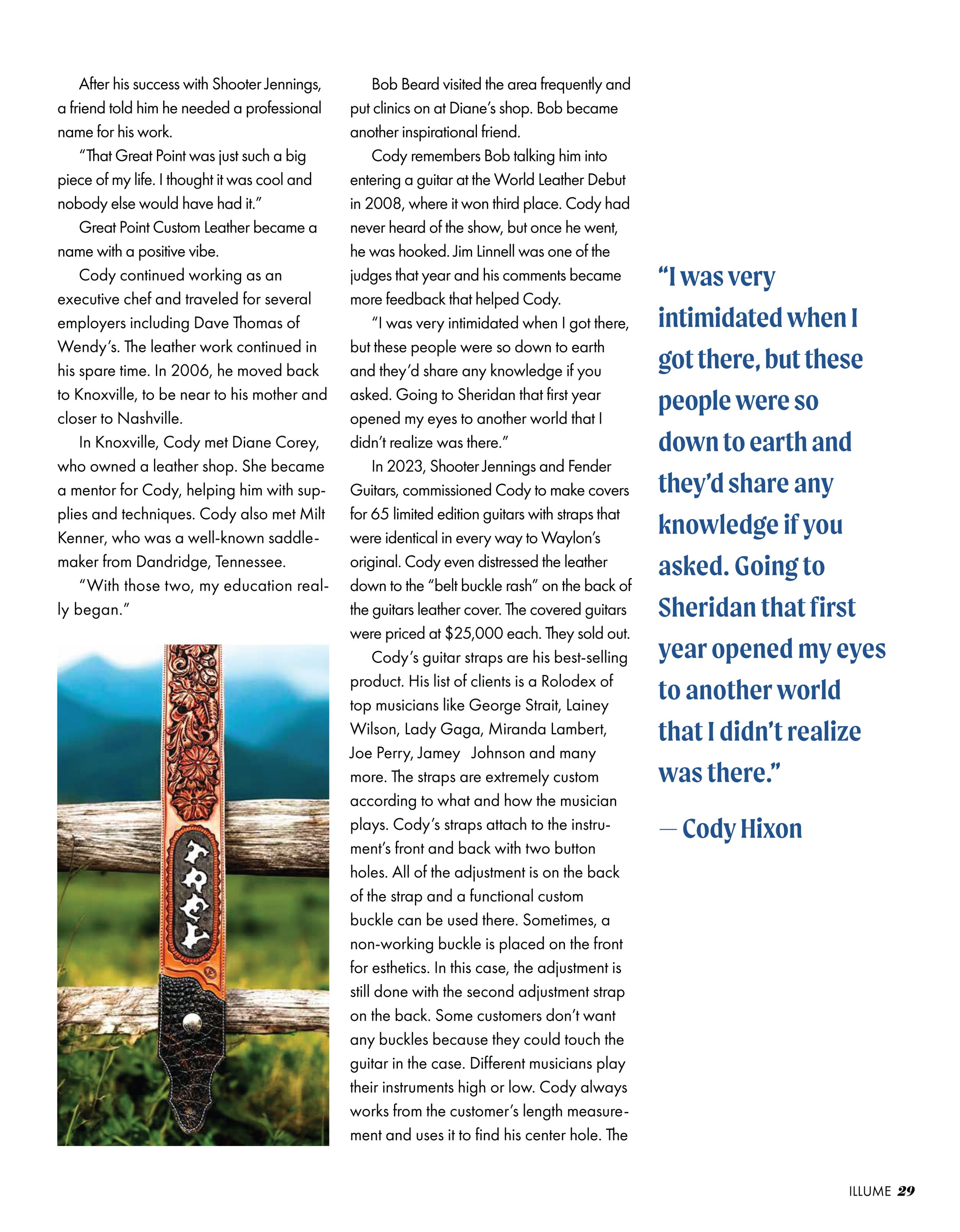
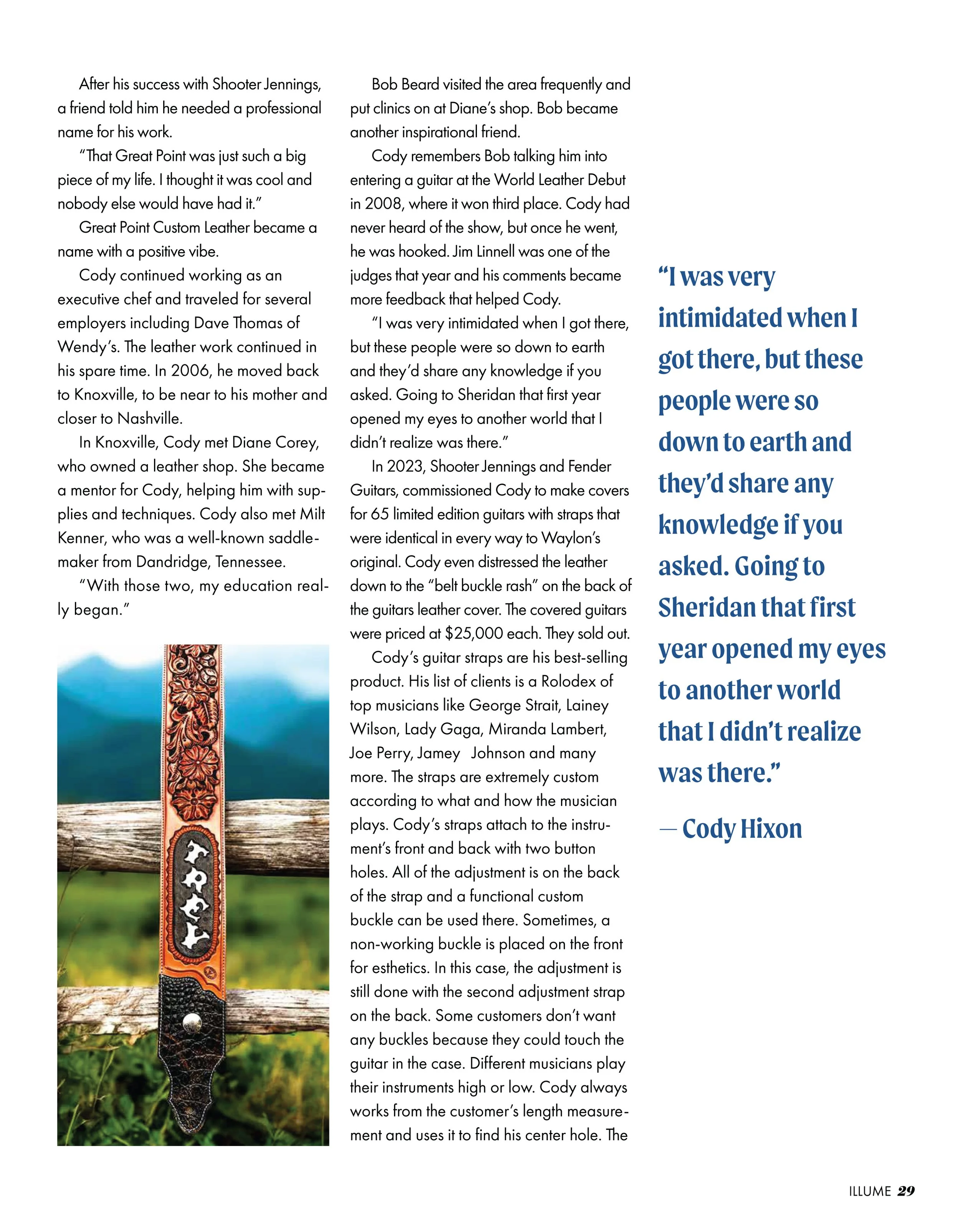
Cody’s guitar straps are his best-selling product. His list of clients is a Rolodex of top musicians like George Strait, Lainey Wilson, Lady Gaga, Miranda Lambert, Joe Perry, Jamey Johnson and many more. The straps are extremely custom according to what and how the musician plays. Cody’s straps attach to the instrument’s front and back with two button holes. All of the adjustment is on the back of the strap and a functional custom buckle can be used there. Sometimes, a non-working buckle is placed on the front for aesthetics. In this case, the adjustment is still done with the second adjustment strap on the back. Some customers don’t want any buckles because they could touch the guitar in the case. Different musicians play their instruments high or low. Cody always works from the customer’s length measurement and uses it to find his center hole. The adjustment strap can be adjusted on both sides of that measurement.
The body of the strap is made from 7 to 8-ounce veg tan tooling leather. The strap is lined with lightweight upholstery leather, with the rough-out surface usually facing out towards the wearer’s shoulder for grip. For the few that want more slide, Cody uses a 3 to 4-ounce veg tan leather, with the smooth side out.
Cody builds guitar covers for both acoustic and electric guitars.
“The first thing I tell the customer is that it will change the (acoustic guitar) sound. There’s no way around it.”
Fortunately, most of today’s professionals have pickups in their acoustic guitars to broadcast the sound through an amp. Cody recently made a cover for an early-1900’s Martin guitar, which is a very expensive acoustic guitar. Jeff Tweedy of Wilco wasn’t worried about changing the signature sound of the Martin, as there was a pickup in it. The electric guitar covers are permanently mounted with 3/16-inch veg tanned laced edges. The acoustic guitar covers usually have a zipper, so the case can be removed, and sometimes they are hand or machine sewn. The three most popular cases are reproductions of Elvis Presley’s, Ricky Nelson’s or Buddy Holly’s cases. These were all made for specific guitars. Cody bought those guitars and made specific patterns for each one. For the electric guitars, Cody prefers to have the guitar in his shop to install the case. He does offer an option for valuable guitars, whose owners do not want to leave it or ship it somewhere. Cody can make the case with prepunched lace holes and the client can follow instructions to lace it together themselves. The price is cheaper and the case comes with three videos of instruction.
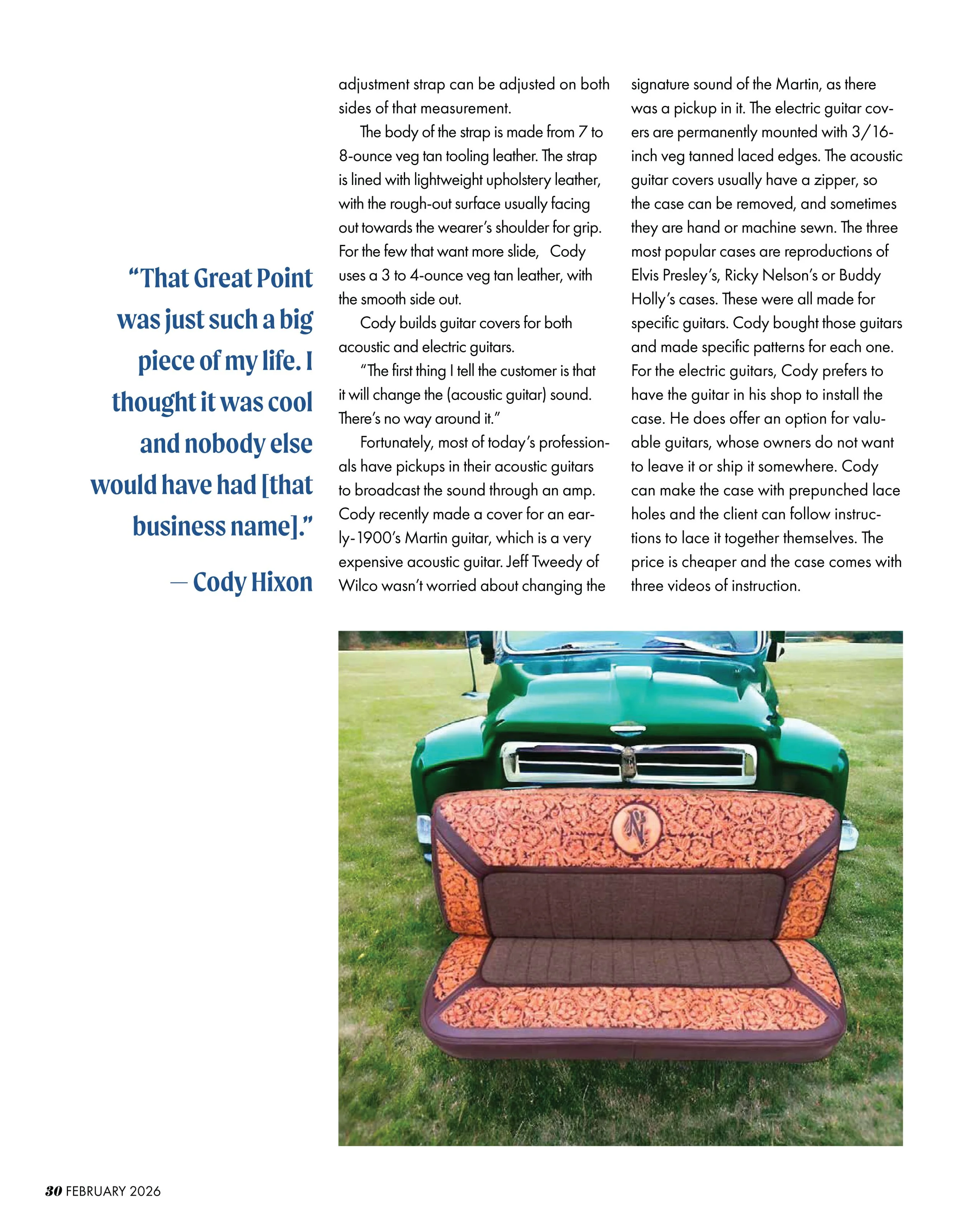
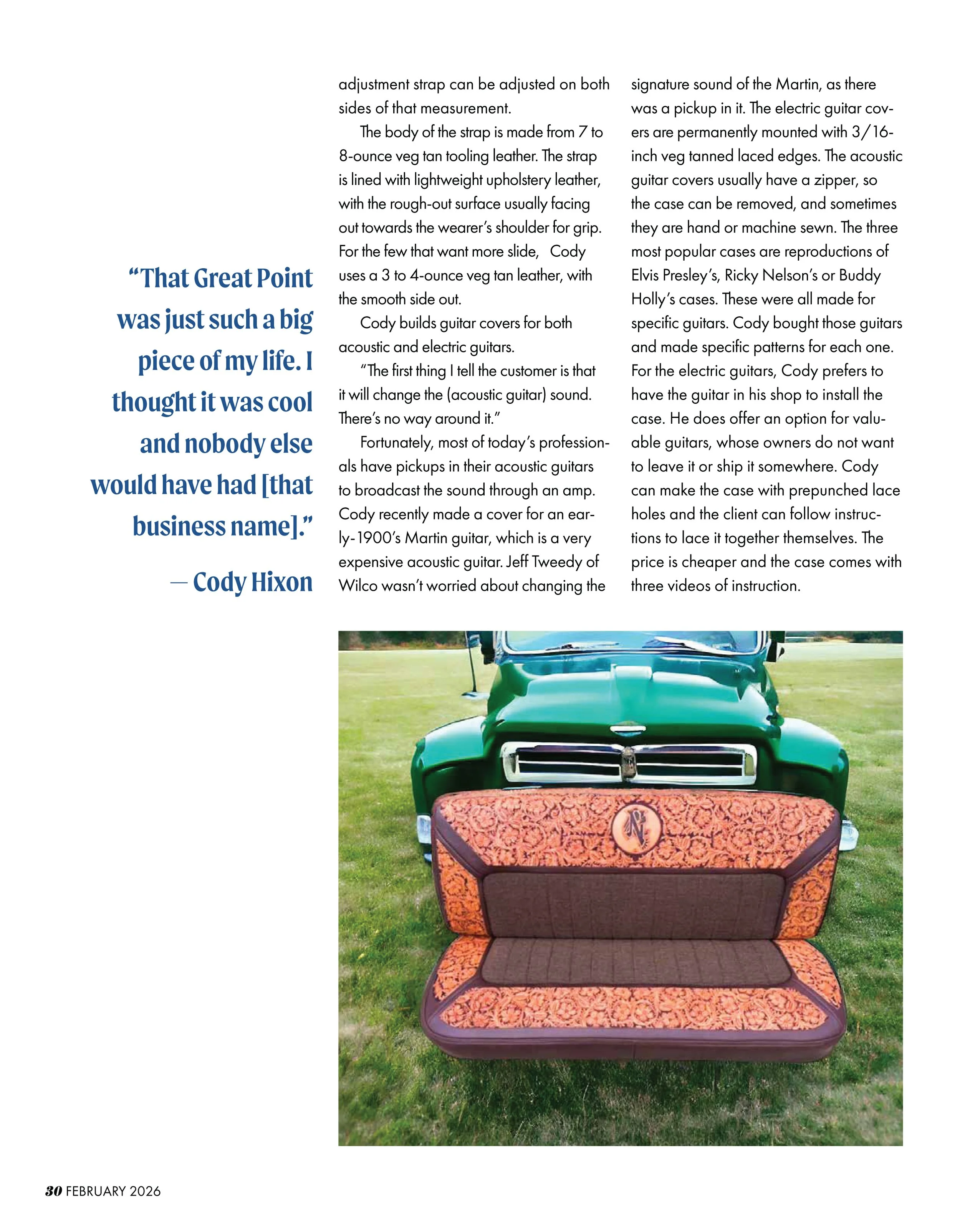
Cody does other projects besides guitar accessories, but a lot of them tie back to the music industry. He completely covered the interior of Gunnar Nelson’s 1950’s Ford pickup with carved leather. Gunnar is Ricky Nelson’s son, and Cody has also covered several guitars for him and his brother, Matthew.
As far as outside the music world, Cody’s most unusual project has been covering the front desk of the Surrey Hotel in New York City in an upholstery leather. The two-tone pattern was mounted on eight-foot wooden panels provided by the hotel, and Cody also had to make a Star of David-type pattern with decorative upholstery tacks over the leather.
Cody continues to work as an executive chef for Buddy’s Bar-B-Q in Knoxville. Cody runs their special events banquet operation.
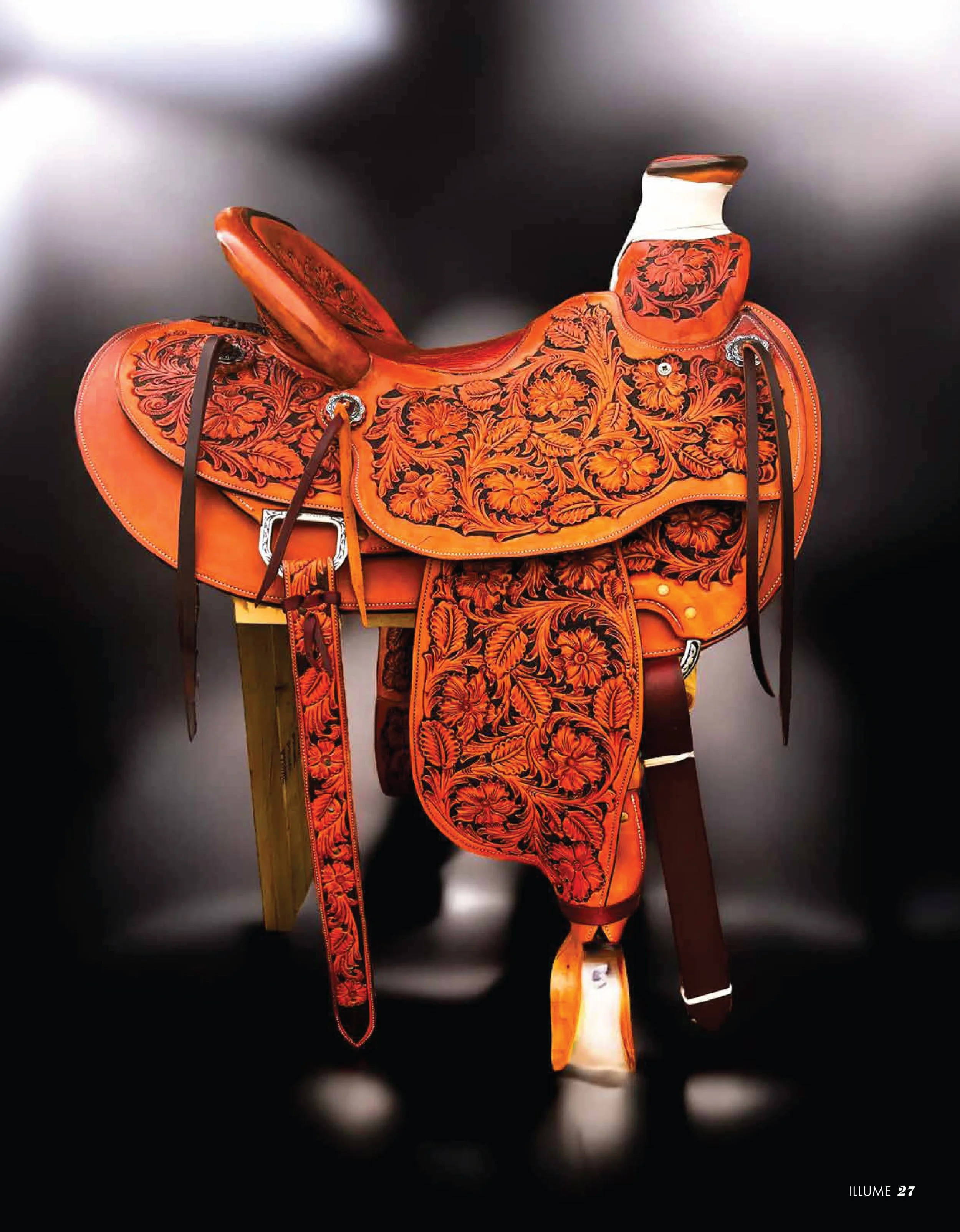
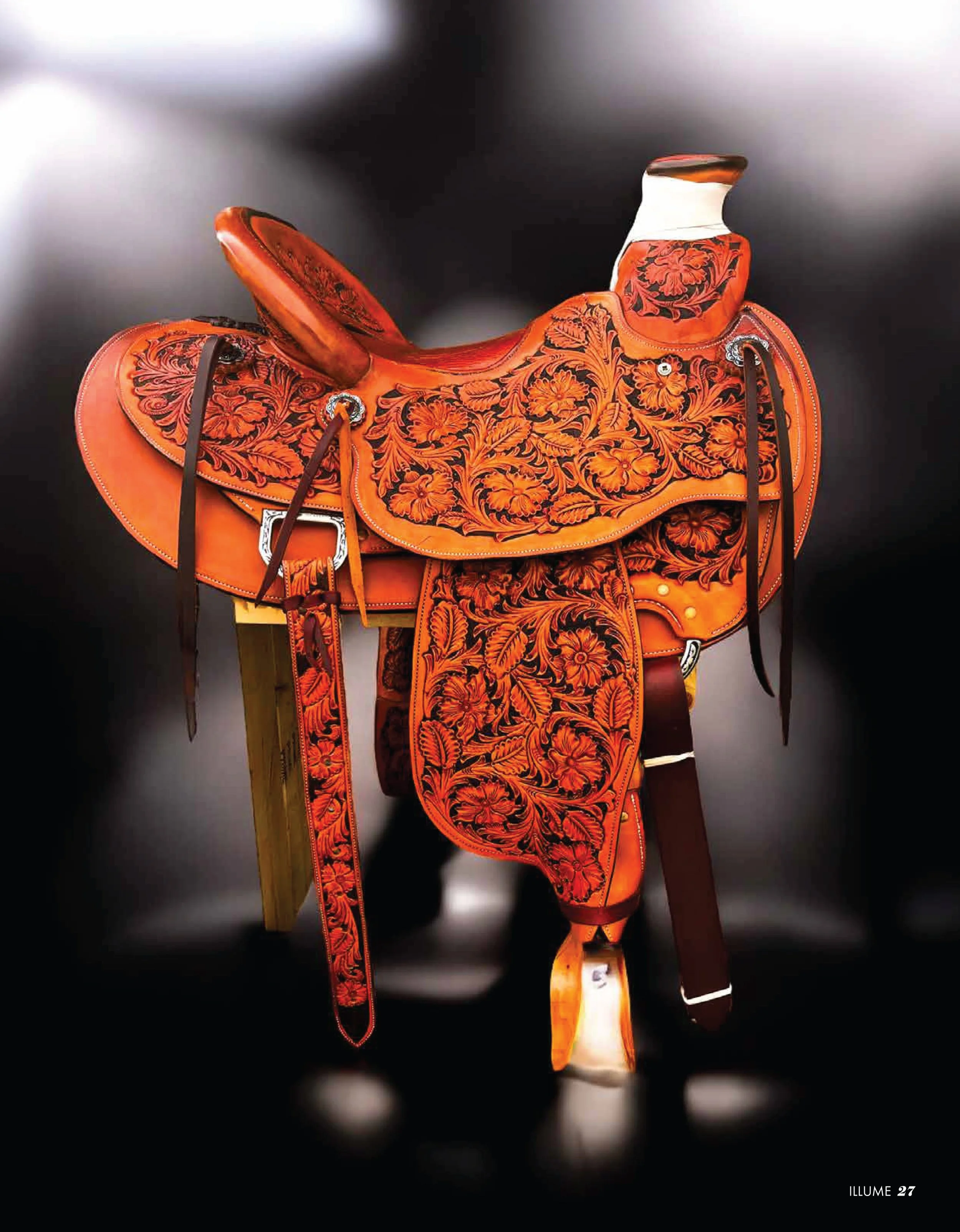
At 60, Cody is still exploring new frontiers in leather. He just built his first saddle, a 16-inch Wade, under Milt Kenner’s tutelage. The saddle was given to musician Jamey Johnson to be auctioned off for his Give It Away Foundation. The foundation benefits many charitable causes.
With Cody’s lifelong immersion in the music business, you might wonder if he has any musical aspirations himself.
“I don’t know the first chord on a guitar,” laughs Cody. “I can barely turn the radio on.”
To find out more about Great Point Custom Leather, you can go to Cody’s website at blue-fish-3ms9.squarespace.com, call him at (803)-467-3080, or find him on Facebook, Instagram or TikTok.
Great Point Custom Leather
7527 Granda Dr.
Knoxville, TN 37909